

GFRG
GFRG is an innovative building system that enables faster construction, superior structural performance, and sustainable development. Designed to improve efficiency and reduce environmental impact, it provides a smarter approach to modern building projects.
GFRG is an innovative building system that delivers faster, stronger, and more sustainable construction.
Building Smarter with GFRG Technology
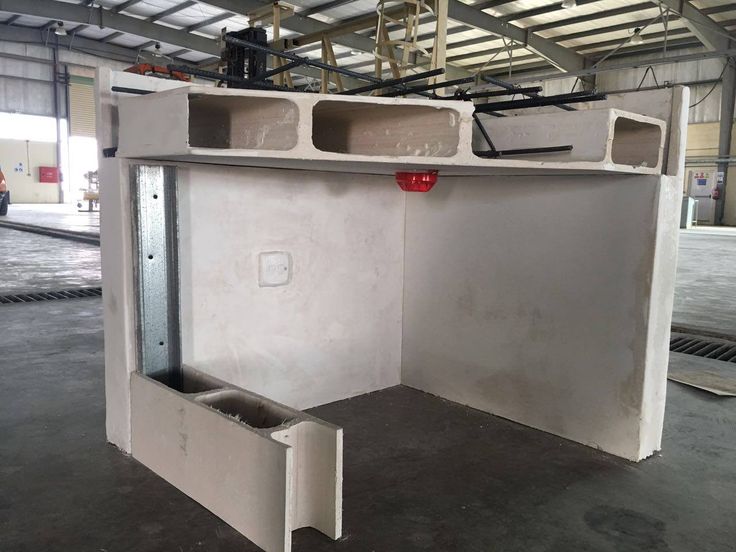
Glass Fibre Reinforced Gypsum (GFRG) is a prefabricated building system comprising large, hollow-core gypsum panels reinforced with glass fibres.
Originally developed in Australia in the 1990s using gypsum recovered as a by-product of industrial processes, GFRG panels provide a lightweight, high-strength alternative to traditional masonry and concrete construction.
The panels can be used as load-bearing walls, non-load-bearing partitions, floors and roof elements, making them suitable for a wide range of residential, commercial and institutional buildings.
Importantly, GFRG fits well with Noventum’s core aims: when combined with modern insulation, airtightness detailing, mechanical ventilation with heat recovery (MVHR) and high-efficiency indoor air source heat pump water heaters, GFRG provides a robust platform for delivering low-carbon, high-performance buildings with Passivhaus performance—meeting increasingly demanding environmental standards.
Key Highlights

Structural
Versatility
Used as structural concrete-filled external walls, internal partition walls, and lost formwork for suspended floors.

4-Hour Fire
Resistance
Gypsum is inherently non-combustible, while concrete-filled GFRG panels can provide up to four hours of fire resistance, enhancing safety and protection in building applications.

Flexible Design Applications
Can also be used as curtain walls for conventional reinforced concrete column-and-beam structures.

Rapid
Installation
A team of four can typically install a wall or floor panel in approximately 20 minutes, regardless of panel length.

Cost savings
Reduced labour requirements, faster programmes, efficient manufacturing (less defects), reduced reliance on skilled labour.

Environmentally friendly
GFRG utilises gypsum, including recycled and industrial by-product gypsum, reducing waste and embodied carbon.
Proven Performance
GFRG has demonstrated its ability to support fast and efficient construction on large-scale projects. Experienced installation teams have achieved 54 panels in a single day, highlighting the system’s potential to significantly accelerate construction programmes.
A major project in the Kingdom of Saudi Arabia saw 28 six-storey buildings reach the lock-up stage within 12 months. The project was delivered with a workforce of 156 people, with one Potain 50 crane shared between every two buildings, demonstrating GFRG’s suitability for large-scale construction with efficient use of labour and equipment.
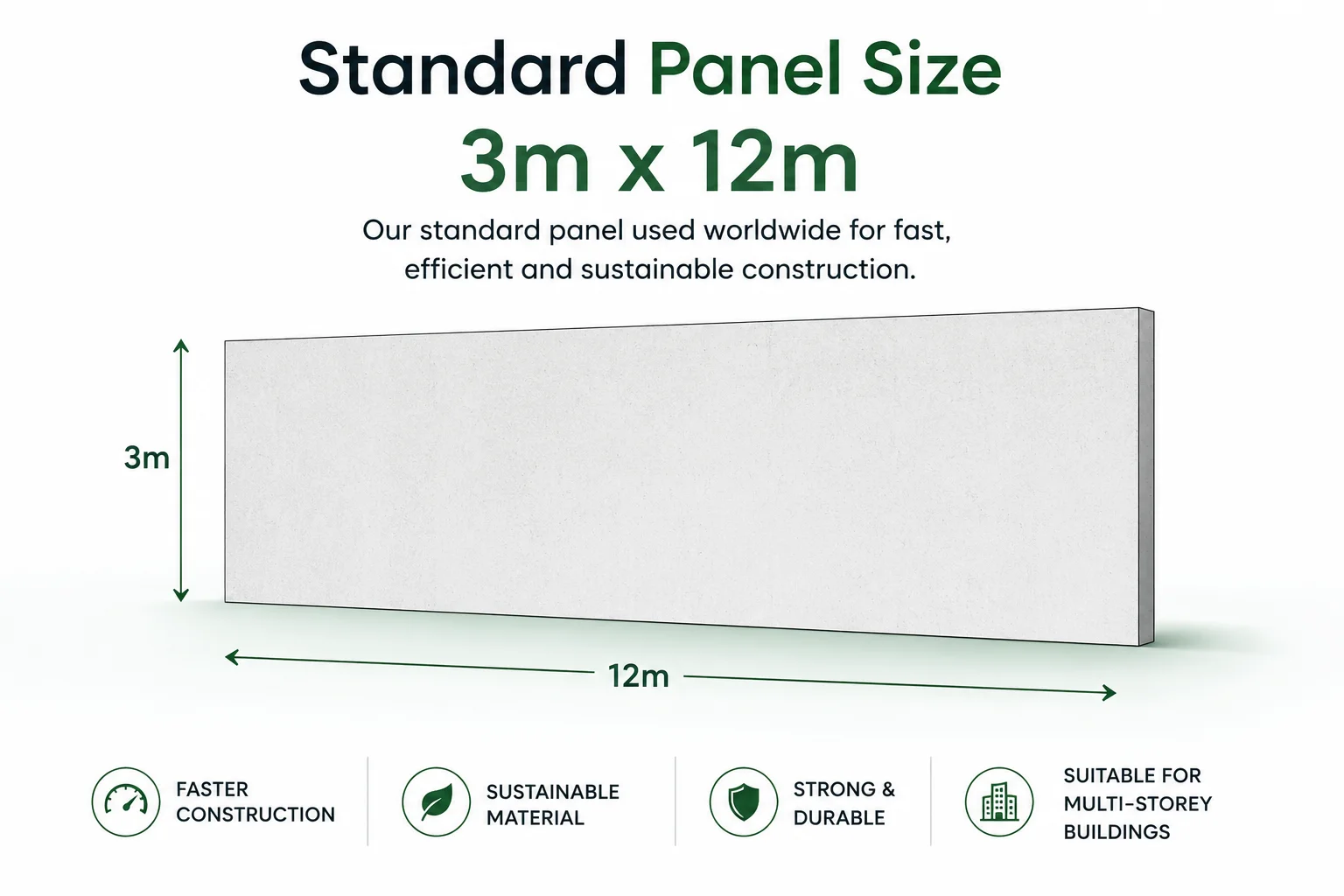
Panels dimensions:
This standardised size help streamline installation while maintaining consistency and construction efficiency.
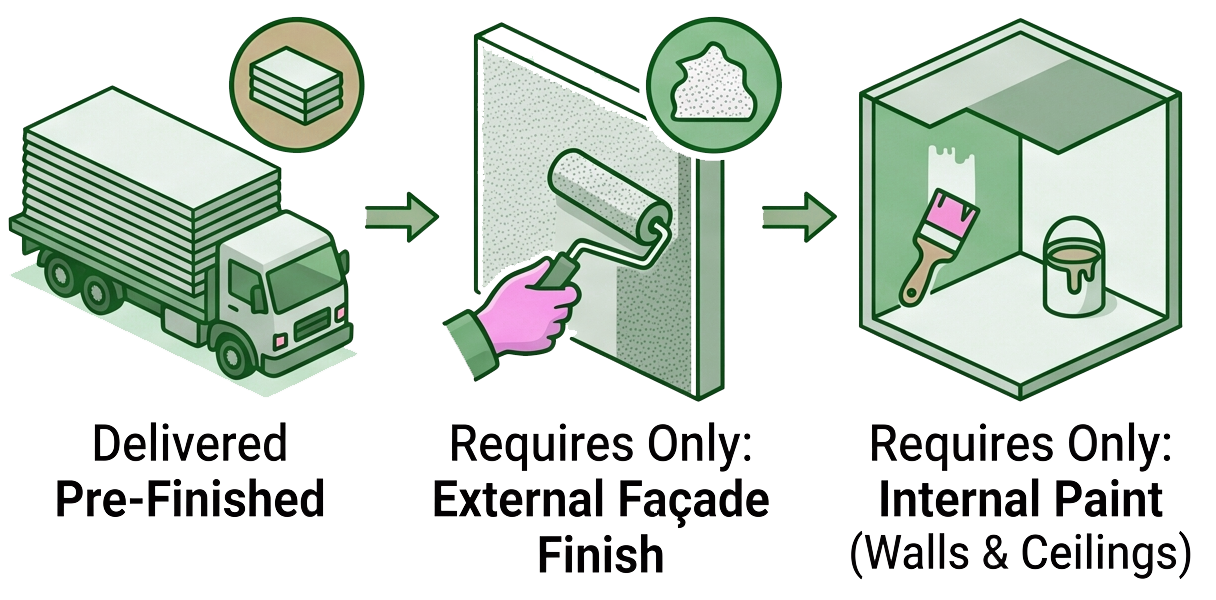
Ready-to-Finish System
- GFRG panels are delivered pre-finished, requiring only the application of the external façade finish and internal paint to walls and ceilings.
- This significantly reduces on-site finishing work, helping projects achieve faster completion with improved quality.
GFRG India Case Study
Glass Fibre Reinforced Gypsum (GFRG) is an eco-friendly, prefabricated building material used for load-bearing walls and slabs. Developed in Australia, GFRG panels use industrial phosphogypsum waste and offer significant reductions in construction time, along with strong performance in earthquake-prone areas.
Quick Facts
Rigorously certified by IIT Madras and the Structural Engineering Research Centre (SERC) for structures up to 10 stories in seismic zones.
Construction Time
Up to 70% faster than traditional brick and concrete. A full two-story house can be completed in approximately 30 days.
Cost & Market Overview
Depending on the scale of the project, with turnkey construction for a full house starting around US$150/SQM
Competitiveness
While raw material costs can sometimes exceed traditional brick, overall costs balance out due to reduced foundation requirements and lower on-site labor.